Dodge Charger Exhaust Guide: Stock System, Mid-Muffler Delete, Tips and What Changes the Sound

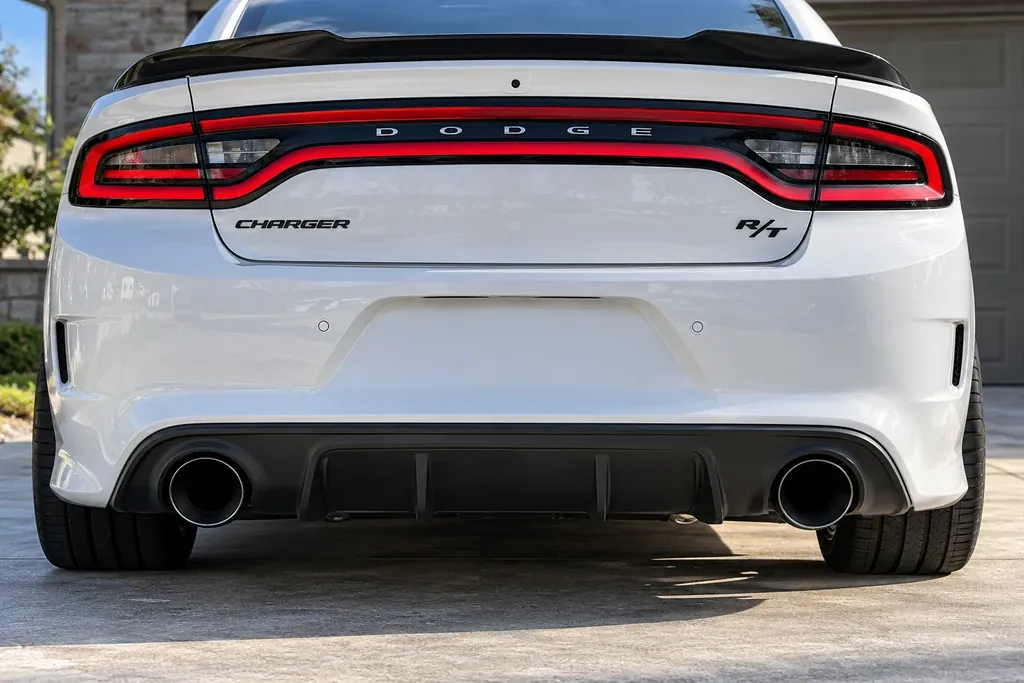
The 2015–2023 Dodge Charger exhaust system runs from the engine through two catalytic converters, a crossover pipe, two mid mufflers under the middle of the car and two rear resonators (mufflers) near the bumper. On the V8 cars, removing the mid mufflers is the cheapest real sound change, a cat-back is the best all-round upgrade, and new tips finish the look. On the V6, a cat-back made for the 3.6 is the only change that really matters.
We make exhaust tips for the Charger, so we spend a lot of time under the back of these cars. This guide explains how the stock exhaust is laid out on each engine, how many mufflers your car has, what the active exhaust valves do, and how much sound and power each mod adds. It covers the 2015–2023 car (the LD generation). If you want the wider list of upgrades, from tint to horsepower, see our Dodge Charger mods guide.
| Exhaust mod | Sound change | Horsepower | Rough cost | Fits |
|---|---|---|---|---|
| New exhaust tips | Very little, a slightly fuller note | None | $100–$250 | 2017–2023 V8 and 2015–2023 Hellcat |
| Mid-muffler delete | Clearly louder and deeper, some highway drone | A small gain, a few hp | $50–$200 DIY, $150–$400 at a shop | All V8 cars |
| Resonator delete (rear mufflers) | Very loud, often raspy, lots of drone | A small gain, a few hp | $100–$400 | V8 cars (V6 possible, sounds poor) |
| Cat-back system | Louder and deeper with drone control | About 10–20 hp at the wheels | $1,000–$2,500 | Every engine, with the right system |
| Long tube headers | Louder and sharper, plus power | 20–40 hp with a tune | $1,500–$2,500 plus install and tune | V8 cars, often not emissions legal |
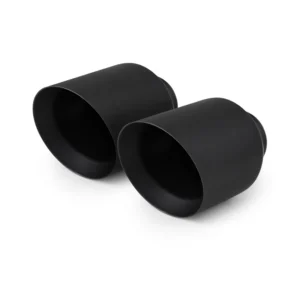
If you only want the back of a V8 Charger to look finished, tips are the quickest win. The factory tips look small inside the big round openings in the lower bumper. Our 5-inch black exhaust tips for the 2017–2023 V8 Charger (and every 2015–2023 Hellcat) fill those openings and bolt on in about 1 hour with the factory collar clamps.
GridReady product
Dodge Charger 5-inch Black Exhaust Tips
- Fits 2017–2023 V8 Charger (R/T, Scat Pack, SRT) and the 2015–2023 Charger Hellcat
- Ceramic-coated black over 304 stainless steel
- Bolt-on with the factory clamps, no cutting or welding required
In this guide
- How the stock Charger exhaust system is laid out
- How many mufflers does a Charger have?
- Active exhaust and the exhaust valve actuator
- Mid-muffler delete
- Mid-muffler delete vs resonator delete vs cat-back
- How much horsepower exhaust mods add
- Exhaust tips that fit the Charger bumper
- V6 Charger exhaust: what actually works
- Legal and warranty notes
- FAQ
How the stock Dodge Charger exhaust system is laid out
On the V8 Chargers, each side of the engine has its own exhaust manifold and catalytic converter, and the two sides are joined by a crossover pipe. Two pipes then run back under the car. Each one goes through a mid muffler under the middle of the car and a rear resonator (the rear muffler) just in front of the rear bumper, then out through a tip. What changes between engines is the pipe size, the sound tuning and whether the car has active exhaust valves. The V6 uses its own smaller, quieter system.
| Engine | Trims | Stock sound | Active valves |
|---|---|---|---|
| 3.6 Pentastar V6 | SXT, GT | Quiet, smooth | No |
| 5.7 Hemi V8 | R/T | Mild V8 rumble, quiet at cruise | Standard from 2017 |
| 6.4 (392) Hemi V8 | Scat Pack, SRT 392 | Deep, gets loud when the valves open | Yes, standard |
| 6.2 supercharged Hemi V8 | SRT Hellcat, Redeye, Jailbreak | Loud with supercharger whine | Yes, standard |
3.6 V6 (SXT and GT)
The V6 exhaust is built to be quiet. The pipes are smaller than on the V8 cars, and the rear bumper doesn’t have the large round tip openings of the 2017–2023 V8 cars. It is a perfectly good exhaust for daily driving, but there is little sound in it to unlock. More on that in the V6 section below.
5.7 Hemi (R/T)
The R/T is the car most owners want to make louder. From the factory it has a nice rumble at startup and on throttle, but it is quiet at highway speed. The mid muffler and the rear resonator on each side do a lot of silencing, so removing the mid mufflers makes a big difference here. For 2017, Dodge made a 2.75-inch active exhaust standard on every 5.7 Charger, so 2017–2023 R/T cars have the same valves as the 392 cars. Earlier R/T cars don’t have them.
6.4 / 392 Hemi (Scat Pack and SRT 392)
The 392 cars sound much bigger from the factory, mostly because of the active valves in the rear resonators. In Sport or Track mode, or when you get on the throttle, the valves open and the car gets loud. At cruise they close again. Aftermarket systems for the 392 usually use 3-inch pipes.
6.2 Hellcat
The Hellcat has the same basic layout with larger pipes and active valves. Its sound is as much supercharger whine as exhaust. Hellcat owners usually change the exhaust for a deeper tone or to save weight, not for volume.
How many mufflers does a Dodge Charger have?
A 2015–2023 Charger has four: two mid mufflers under the middle of the car and two rear mufflers near the bumper. In the Mopar scene the rear ones are usually called resonators, so when Charger owners talk about a “resonator delete”, they mean removing the rear mufflers. Because of the different names, you will see different counts online. For a sound mod, the four big cans are what matter.
Why is there a mid muffler at all? The Charger is a long, heavy car that Dodge also sold as a quiet family sedan. Two mufflers in a row take out more of the low “drone” frequencies at highway speed than one could on its own. That is also why the mid mufflers are the first thing owners remove: they are easy to reach, and the rear resonators still keep the sound under control.
Active exhaust and the exhaust valve actuator explained
On cars with active exhaust, each rear resonator has a valve inside it. When the valve is closed, the exhaust goes through the quiet path inside the resonator. When it opens, the exhaust takes a more direct path and the car gets much louder. A small electric motor on each tailpipe, the exhaust valve actuator, opens and closes the valve. You can see them from below: a black box with a wiring plug, bolted to each pipe near the rear resonator.
The engine computer decides when the valves open. They open in Sport or Track mode, at higher rpm and under heavy throttle. They close at cruise, and on automatic cars with cylinder deactivation (MDS, when the engine runs on four cylinders to save fuel) to keep the drone down.
Common actuator problems
- Rattle or buzz from the back of the car: often a worn actuator or a loose linkage between the actuator and the valve. It is usually worse at idle or on startup.
- The car stays quiet in Sport mode: a valve stuck closed, a failed actuator or a damaged plug. Road salt and dirt are hard on these parts.
- Warning light after an exhaust change: if the valves are removed and nothing replaces them, the computer sees a missing actuator. Most cat-backs for valved cars either keep the factory valves or come with plugs that tell the computer everything is fine (often called valve simulators).
A replacement actuator from Mopar or an aftermarket supplier is a bolt-on part, but the exact part depends on the year and engine, so order by VIN.
Mid-muffler delete: the cheapest real sound change
A mid-muffler delete replaces the two mid mufflers with straight pipes. On a 5.7, 6.4 or 6.2 Hemi it gives a clearly louder, deeper sound, louder cold starts and more crackle when you lift off the throttle. The rear resonators stay, so the car does not turn into a straight pipe.
- Cost: bolt-on kits cost about $50 to $200. A shop that cuts and welds usually charges $150 to $400 in total.
- Power: a small gain, usually a few horsepower and a slightly sharper throttle feel. It adds up when you combine it with other exhaust parts and a tune, but on its own most owners do it for the sound.
- The catch: drone. On many cars there is a boom inside the cabin at highway cruising speed, and it is worse on automatic cars when MDS switches to four cylinders. Some owners love it, some regret it after the first long trip.
Our mid-muffler delete guide for the Charger and Challenger goes into kits, sound clips and how to keep the drone down. On a V6 we don’t recommend it. It mostly makes the car sound raspy.
Mid-muffler delete vs resonator delete vs cat-back on a Charger
These three get mixed up a lot online, partly because different sellers use different names for the same parts. On a Charger it works like this:
| Mid-muffler delete | Resonator delete (rear mufflers) | Cat-back system | |
|---|---|---|---|
| What is removed | The two mid mufflers | The two rear resonators | Everything from the catalytic converters back |
| Sound | Louder, deeper | Very loud, often raspy | Depends on the system, from mild to loud |
| Drone | Some | A lot | Low on a good system |
| Active valves | Kept | Usually lost | Kept or replaced, depends on the system |
| Cost | $50–$400 | $100–$400 | $1,000–$2,500 |
A full delete of the mid mufflers and the rear resonators is basically a straight pipe from the cats back. It is very loud, and on a street car we don’t recommend it. Our muffler delete guide covers the pros and cons in general, and the straight pipe guide explains why we steer people away from it.
Cat-back brands for the Charger
A cat-back costs more, but it is engineered for the car, so it sounds good and keeps drone in check. These are the brands most Charger owners compare:
- Borla: Touring (mild), S-Type (sporty) and ATAK (loudest). Known for good drone control. Versions with active valves for the valved cars.
- Corsa: Sport and Xtreme. A deep tone and very little drone inside the car.
- MagnaFlow: the xMOD system lets you swap mufflers to change the volume later. Often a bit cheaper.
- Flowmaster: American Thunder and Outlaw for the V8, FlowFX for the V6. The classic aggressive Flowmaster sound.
- Mopar: the factory performance brand, a safe choice if you worry about the warranty.
Before you buy, check that the system matches your engine and whether your car has active valves. Also check whether it comes with its own tips. Many do, and some reuse the factory tips.
Headers
Headers replace the factory exhaust manifolds at the front of the system. The factory manifolds are the most restrictive part of the stock exhaust, so long tube headers from brands like Kooks, American Racing Headers or Stainless Works add real power on a Hemi. In one magazine dyno test on a 2015 Scat Pack, long tubes added 26 hp at the rear wheels, and with a tune 20 to 40 hp is common. They also make the car sharper and louder. They cost $1,500 to $2,500 plus installation, most need a tune to run right, and many are not emissions legal. The same goes for the mid-pipe that connects them: a catted mid-pipe keeps the catalytic converters, a catless one is illegal on the street. In strict states, look for a CARB EO number. For more on power mods, see the horsepower section of our Charger mods guide.
How much horsepower do exhaust mods add to a Charger?
Exhaust mods do add power on a Hemi, because the engine can push its exhaust out more easily. The stock Charger exhaust runs every pipe through a mid muffler and a rear resonator and starts with cast iron manifolds, which are built for quiet and low cost, not flow. The further forward in the system you go, the bigger the gain: tips add nothing, mufflers and cat-backs add a little to a fair amount, and headers add the most. A tune adds more on top, because it adjusts fuel and timing to the freer exhaust.
| Exhaust mod | Typical gain on a Hemi (at the wheels) | Good to know |
|---|---|---|
| Exhaust tips | None | Tips sit after the rear resonator, so they change the look and only a little of the sound. |
| Mid-muffler delete | A few hp | A small gain on its own, hard to separate from normal dyno variation. Bigger as part of a full exhaust with a tune. |
| Resonator delete (rear mufflers) | A few hp | Similar to the mid-muffler delete, but much louder and raspier. |
| Cat-back system | About 10–20 hp | Makers’ dyno tests on the 5.7 Hemi show gains in this range, with more torque too. Gains are larger after a tune. |
| Long tube headers with a catted mid-pipe | About 20–40 hp, the top end with a tune | The biggest exhaust gain, because the factory manifolds are the tightest part of the system. |
| Headers, cat-back, intake and tune together | Often 40–60 hp on a 6.4, a bit less on a 5.7 | The parts work best together once the tune is matched to them. |
Two things to keep in mind when you compare numbers. First, the gains above are measured at the rear wheels on a chassis dyno, which reads roughly 10 to 15 percent lower than the engine (crank) figures Dodge advertises. Second, different dynos read differently, so only compare before and after numbers from the same dyno. On the 3.6 V6, exhaust mods add only a few horsepower. On a Hellcat, a full exhaust adds more once the car is tuned, but the biggest gains there come from a smaller supercharger pulley. Our Charger mods guide covers intakes, tunes, cams and superchargers for every engine.
Exhaust tips: sizes that fit the Charger bumper cut-outs
Tips are the part of the exhaust everyone sees. They change the look of the rear far more than the sound. Owners tell us the tone gets a little fuller with larger tips, but nobody will think you fitted a new exhaust. If you are wondering how much tips can change, our article will exhaust tips change sound? goes into detail, and our guide to resonated exhaust tips covers tips with a small built-in silencer.

| Charger | Rear bumper | Tip upgrade |
|---|---|---|
| 2017–2023 V8 (R/T, Scat Pack, SRT 392) | A large round opening on each side of the lower valance, factory tips held on with collar clamps | Bolt-on tips. 5-inch tips fill the openings properly |
| 2015–2023 Hellcat | The same round openings as the 2017–2023 V8 cars | Our 5-inch tips fit |
| 2015–2016 R/T, Scat Pack, SRT 392 | The earlier V8 exhaust (Dodge upgraded it for 2017) | Our tips don’t fit. Measure your tips and openings before buying any tips |
| 2015–2023 V6 (SXT, GT) | No round tip openings | V8 tips don’t fit. Only tips or cat-backs listed for the 3.6 V6 |
5.7 Hemi exhaust tips (and the 392 and Hellcat)
On every 2017–2023 V8 Charger, and on every 2015–2023 Hellcat, the setup is the same: a round tip on the end of each tailpipe, held by a factory collar clamp and sitting inside a round opening in the bumper. The factory tips are noticeably smaller than those openings, which is why they look lost. We sized our Charger exhaust tips at 5 inches because that is the size that fills the opening without touching the bumper. Swapping them takes about 1 hour: loosen the clamp, pull the old tip, slide the new one on, line it up and tighten. Our exhaust tips guide explains sizes, finishes and materials if you want to compare options.
V6 Charger exhaust: what actually works
A lot of SXT and GT owners want their car to sound more like the V8. Honestly, it never will. The 3.6 Pentastar is a smooth six-cylinder, and removing mufflers mostly makes it raspy rather than deep. Here is what does work:
- A cat-back made for the V6: Flowmaster FlowFX, Borla and MagnaFlow all make systems for the 3.6 Charger. They give a sportier tone without the rasp, and some include dual tips.
- Exhaust tips for the V6: because the V6 bumper has no round openings, V8 tips (including ours) don’t fit. Only buy tips listed for the V6 Charger and your exact years.
- Skip: mid-muffler deletes and straight pipes on the V6. They add noise, not sound quality.
If sound is the main reason you want to mod your car, our honest advice is the same as in our Charger mods guide: spend on looks, tires and comfort on the V6, and buy an R/T or Scat Pack when you want the Hemi sound.
Legal and warranty notes

Noise and emissions
- Catalytic converters: removing or disabling them on a road car is illegal everywhere in the US under federal law. Mid-muffler deletes, resonator deletes, tips and cat-backs all keep the cats.
- Noise limits: most states have a rule against “excessive or unusual” exhaust noise, and some set a decibel limit. California, for example, uses a 95 decibel limit for passenger cars. A cat-back from a big brand is usually designed to stay within the limits. Deletes often are not.
- Headers: the mod most likely to fail an emissions inspection. Look for a CARB EO number if you live in California or another state that follows its rules.
This is not legal advice, and the rules change. Check your state’s rules before you go loud.
Warranty
Changing the exhaust does not void your whole warranty. Under the federal Magnuson-Moss Warranty Act, the dealer has to show that your part caused a problem before they can refuse that repair. The FTC explains this in its guide to auto warranties. In practice, tips and cat-backs cause no trouble. If you remove the active valves without simulators and get a fault code, the dealer can fairly blame the exhaust for that fault. Keep the factory parts in case you want to go back to stock or sell the car.
Related guides
- Dodge Charger mods and accessories guide
- Dodge Challenger and Charger mid-muffler delete guide
- Exhaust tips explained: sizes, styles, materials and how to choose
FAQ
How many mufflers does a Dodge Charger have?
A 2015–2023 Charger has four: two mid mufflers under the middle of the car and two rear resonators (mufflers) near the bumper. Because Mopar owners call the rear ones resonators, you may see different numbers online.
What size are the stock Charger exhaust tips?
Dodge doesn’t list the factory tip size, so measure the outside diameter of yours with a tape. On the 2017–2023 V8 Charger and every 2015–2023 Hellcat, the factory tips look small inside the round bumper openings, and our 5-inch tips fill them.
Does a mid muffler delete void the warranty?
No, not the whole warranty. Under the Magnuson-Moss Warranty Act, the dealer must show that the delete caused a specific problem before refusing that repair. A mid-muffler delete keeps the catalytic converters and the active valves, so it rarely causes warranty trouble.
What exhaust tips fit a Charger SXT?
Tips made for the V8 Charger don’t fit the SXT or GT, because the V6 bumper has no round tip openings. Look for tips listed for the 3.6 V6 Charger and your years, or a V6 cat-back that comes with its own tips.
Is a muffler delete loud on a 5.7 Hemi?
A mid-muffler delete on a 5.7 is clearly louder and deeper, with loud cold starts and some drone at highway speed. Adding a resonator delete (removing the rear mufflers) makes it very loud and often raspy, which most owners regret on long drives.
Does a mid muffler delete add horsepower to a Charger?
A little, usually a few horsepower on its own. Most owners do it for the sound. For bigger gains on a Hemi, a cat-back adds about 10 to 20 hp at the wheels, and long tube headers with a tune add the most.
Why is my Charger exhaust rattling?
On cars with active exhaust, a rattle or buzz from the back is often a worn exhaust valve actuator or a loose linkage on one of the rear resonators. Loose heat shields and worn exhaust hangers are the other common causes.
How much horsepower does a cat-back add to a Charger?
On a 5.7 Hemi, makers’ dyno tests show about 10 to 20 hp at the rear wheels, plus some torque, and a bit more after a tune. Long tube headers with a tune add the most of any exhaust mod, about 20 to 40 hp.