


Dodge Charger and Challenger Mid Muffler Delete Guide: HP, Cost & Sound


Thinking about a mid muffler delete for your Dodge Charger or Challenger? It is one of the first mods most V8 Mopar drivers do, because it costs little and changes the sound of the car more than almost anything else in that price range.
We work on Chargers and Challengers all the time, and a mid muffler delete is one of the mods we see most when these cars come in. In this guide we start with what the mid mufflers are and how the delete compares to other exhaust mods, then we cover cost, sound by engine, horsepower, kits, the Durango SRT and Hellcat, and the legal side. It covers the 2015–2023 Charger and Challenger with the 5.7, 6.4 (392) and 6.2 Hellcat Hemi.
In this guide
- What is a mid muffler delete?
- Mid muffler delete vs resonator delete vs muffler delete
- Mid muffler delete cost
- Sound before and after, by engine
- Does a mid muffler delete add HP?
- Mid muffler delete kits and how to install one
- Durango SRT and Hellcat muffler delete
- Is a mid muffler delete legal? Warranty notes
- Pros and cons
- Finish it with the right exhaust tips
- FAQ
What is a mid muffler delete?
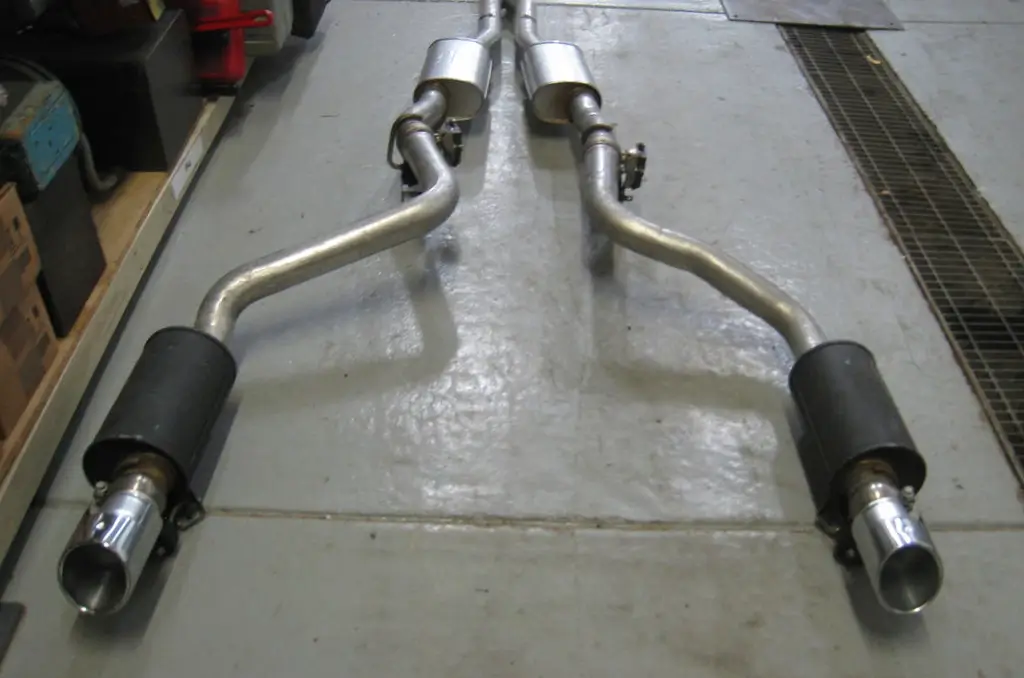
A mid muffler delete replaces the two mid mufflers under your Charger or Challenger with straight sections of pipe. Everything else stays: the catalytic converters, the crossover pipe, the rear resonators and the tips. Only the middle silencers come out, so the exhaust gets louder and deeper without turning into a straight pipe exhaust.
Why are they called mid mufflers?
On the V8 Charger and Challenger, each side of the engine has its own catalytic converter, and the two sides are joined by a crossover pipe. Two pipes then run back under the car. Each pipe goes through two silencers:
- The mid muffler: under the middle of the car, roughly below the front seats. Because it sits in the middle, it is called the mid muffler.
- The rear resonator: just in front of the rear bumper, connected to the tip. In the Mopar scene the rear mufflers are usually called resonators. On cars with active exhaust, the valves sit inside them.
Dodge used two silencers per side because these are long, heavy cars that were also sold as quiet daily drivers. Two silencers in a row take out more of the low drone at highway speed than one could. That is also why the mid mufflers are the first thing to go: they are easy to reach, and the rear resonators still keep the sound under control. Our Dodge Charger exhaust guide shows the full layout for each engine, including the active exhaust valves.
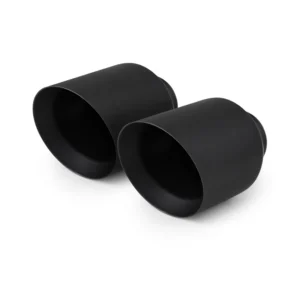
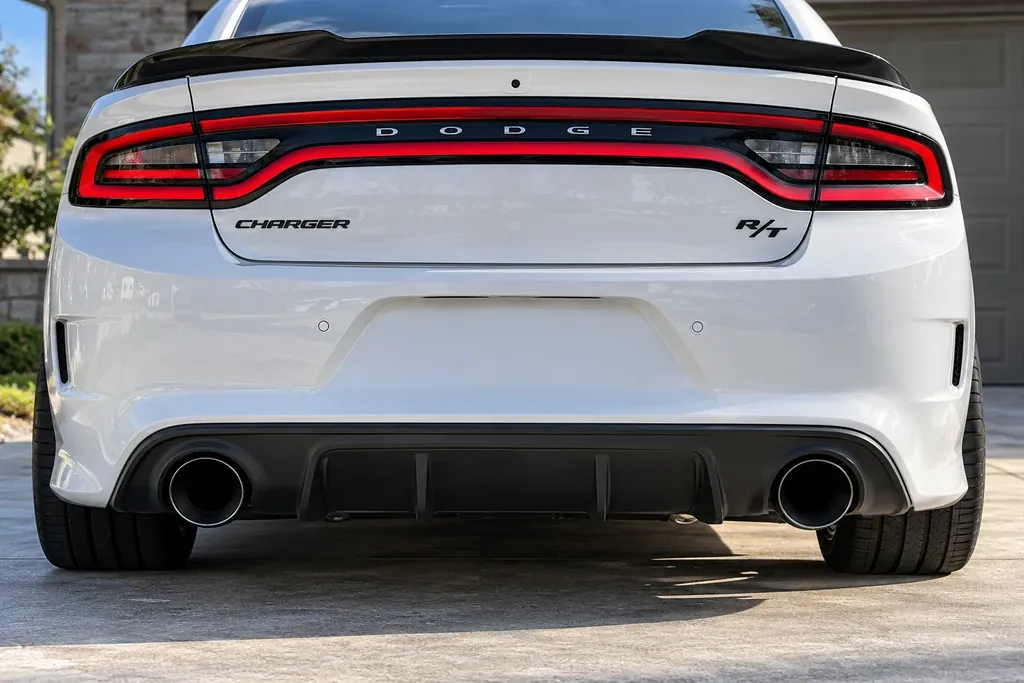
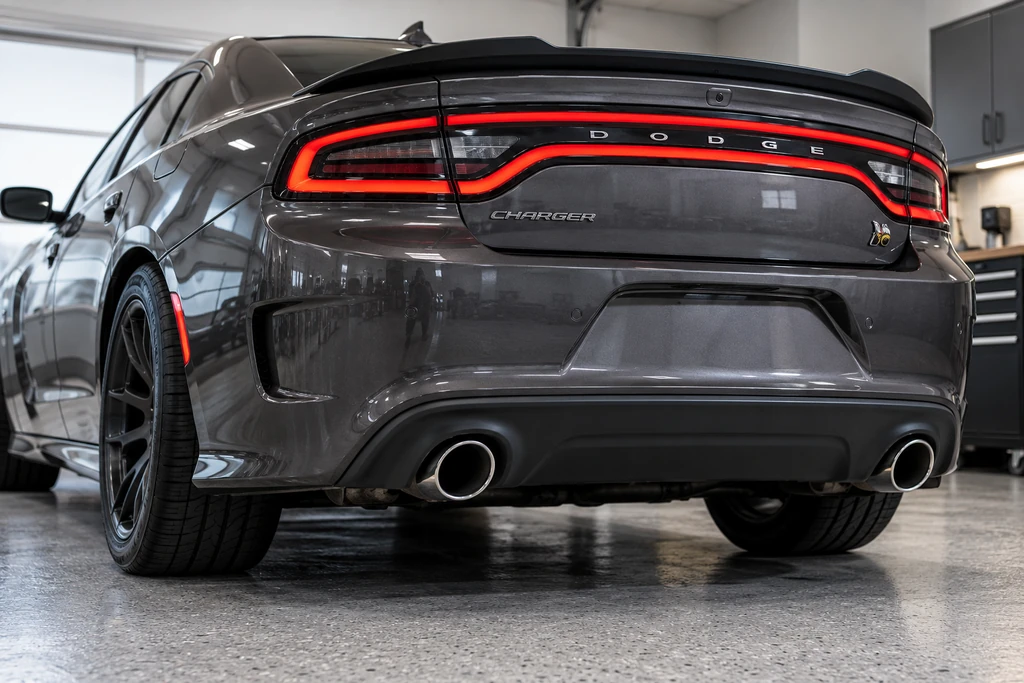
A mid muffler delete leaves the factory tips in place, and on the 2017–2023 V8 cars those tips look small inside the big openings in the rear bumper. If you drive a 2017–2023 V8 Charger or any 2015–2023 Charger Hellcat, our 5-inch black exhaust tips for the Charger fill those openings and bolt on with the factory clamps in about an hour.
GridReady product
Dodge Charger 5-inch Black Exhaust Tips
- Fits 2017–2023 V8 Charger (R/T, Scat Pack, SRT) and the 2015–2023 Charger Hellcat
- Ceramic-coated black over 304 stainless steel
- Bolt-on with the factory clamps, no cutting or welding required
Mid muffler delete vs resonator delete vs muffler delete
These names get mixed up a lot, because different sellers use them for different parts. On a Charger or Challenger it works like this:
For most drivers, the mid muffler delete is the sweet spot. It gives most of the extra sound, keeps the active exhaust working and keeps the drone livable. A resonator delete on top of it makes the car much louder, but also much harder to live with on long drives.
A “muffler delete” on most other cars means removing the one muffler the car has. If you want the general answer, from what a muffler does to whether a muffler delete is worth it on any car, see our guide muffler delete: good idea or not?
Mid muffler delete cost
A mid muffler delete is one of the cheapest exhaust mods for these cars. These are the prices we see in the US at the time of writing:
What changes the price: stainless steel pipe costs more than aluminized steel but lasts much longer, mandrel-bent pipe costs more than crush-bent pipe, and a shop in a big city charges more per hour. If you want to be able to go back to stock easily, a bolt-on kit with clamps is the better choice. A welded setup is cleaner and never works loose.
Sound before and after, by engine
The mid muffler delete makes every V8 Charger and Challenger louder, but the change is not the same on each engine:
You notice the difference most at a cold start, when you accelerate and when you lift off the throttle. At a steady cruise the rear resonators keep it fairly calm, but many cars get some drone in the cabin at highway speed, usually around 1,600 to 2,200 rpm. It is worse on automatic cars with the fuel saver mode (Dodge’s system that runs the engine on four cylinders at cruise to save fuel). Some drivers turn that mode off with a tune, for example from HP Tuners or DiabloSport, which also takes away most of the drone.
If the sound ends up a little too raspy for you, resonated exhaust tips can soften the high notes, although they won’t make the car much quieter.
Does a mid muffler delete add HP?
A little. A mid muffler delete usually frees up a few horsepower, roughly 3 to 10 hp at most, and on its own you will hardly feel it. The mid mufflers are not a big restriction on these engines. You do this mod for the sound.
The gains add up when it is part of a bigger plan: an intake, long tube headers and a tune together make a real difference, and an open mid section helps those parts work. If you want more power, our Dodge Charger mods guide and Dodge Challenger mods guide list the horsepower mods with their gains and costs.
Will it hurt the engine?
No. The mid mufflers sit well behind the catalytic converters and oxygen sensors, so removing them doesn’t change anything the engine computer measures. You won’t get a check engine light, and because the rear resonators stay, the active exhaust valves keep working as before.
Mid muffler delete kits and how to install one
A mid muffler delete kit is simply two pieces of pipe shaped to replace the mid mufflers, with clamps to fit them. Brands such as PLM, Khaos Motorsports and Cornerstone Performance make kits for the Charger and Challenger. What to look for:
- Pipe size: the 6.4 and 6.2 cars use larger pipe than the 5.7, and some kits come in 2.75 or 3 inch. Buy the kit made for your engine.
- Muffler shape: depending on the year and engine, the factory mid mufflers are oval or round. Kits are made for one shape, so check the listing against your car.
- Material: 304 stainless steel lasts the longest. Cheaper aluminized pipe rusts sooner, especially in salty winters.
- Mandrel bends: mandrel-bent pipe keeps its full diameter through the bends, so it flows better than crush-bent pipe.
- Clamps: band clamps seal better than U-bolt clamps and don’t crush the pipe, which makes the kit easier to remove later.
Fitting a bolt-on kit takes about 1 to 2 hours with the car safely on ramps or jack stands. This is how we would do it:
- Let the exhaust cool down completely, then raise the car and support it safely.
- Spray the clamps and hangers around the mid mufflers with penetrating oil.
- Loosen the clamps (or cut the pipe where the kit instructions say, on cars where the mufflers are welded in).
- Pull the mid mufflers off their rubber hangers and take them out.
- Fit the new pipes, line everything up so nothing touches the body or the driveshaft, and tighten the clamps evenly.
- Start the car, check for leaks and rattles, and check the clamps again after the first drive.
Keep the stock mid mufflers. If you sell the car, need an inspection or simply miss the quieter sound, you can put them back in an hour.

Durango SRT and Hellcat muffler delete
The Durango SRT 392 and Durango SRT Hellcat use the same Hemi engines as the Charger and Challenger, so the idea is the same: take out silencers under the middle of the car and the Hemi gets louder. The Durango’s exhaust is its own design, though, made for a longer and taller SUV, so kits made for the Charger and Challenger don’t fit.
- Kits: bolt-on mid muffler delete kits for the Durango are rare. Most Durango SRT drivers either have an exhaust shop cut out the silencers and weld in pipe, or choose a cat-back made for the Durango, for example from Borla or Corsa.
- Sound and drone: a big SUV body booms more than a car, so drone on the highway is more noticeable. Many Durango drivers prefer a cat-back with drone control over a simple delete for that reason.
- Active exhaust: if your Durango has active exhaust valves, keep them in place or use valve simulators, just like on the cars, or you get a warning light.
Have a Durango? See everything we make for it on our Dodge Durango parts page.
Is a mid muffler delete legal? Warranty notes
A mid muffler delete doesn’t touch the catalytic converters, so it doesn’t break federal emissions law, and the rear resonators still work as mufflers. The question is noise. Many states forbid changes that make the exhaust louder than stock or that cause “excessive or unusual noise”, and California has a 95 decibel limit for cars. So whether it is legal depends on your state and on how loud your car ends up. This is general information, not legal advice, and laws change.
On the warranty: in the US, a dealer can’t refuse warranty work just because you fitted an aftermarket part. They can refuse to cover damage the part caused, such as an exhaust leak or rattle in the pipes you changed. Our muffler delete guide goes into the legal and warranty side in more detail.
Mid muffler delete pros and cons
Pros
- Cheap: one of the lowest-cost sound upgrades for a V8 Charger or Challenger.
- A big change in sound: deeper and louder, especially on the 5.7 R/T.
- Keeps the active exhaust: the valves stay in the rear resonators and keep working.
- No check engine light: the catalytic converters and sensors are untouched.
- Easy to undo: with a bolt-on kit, the stock mufflers go back in about an hour.
Cons
- Drone: some boom in the cabin at highway speed, more with the fuel saver mode active.
- Noise laws: depending on your state, it can get you a noise ticket.
- Little extra power: it is a sound mod, not a power mod.
- Not for the V6: it mostly adds rasp on the 3.6.
Finish it with the right exhaust tips
A mid muffler delete changes how the car sounds, but nothing changes at the back of the car. On the 2017–2023 V8 cars the factory tips look small inside the big bumper openings, so new tips are the step people notice. Tips on their own change the sound very little, so they work with any of the setups in this guide. Our exhaust tips guide explains sizes and styles.
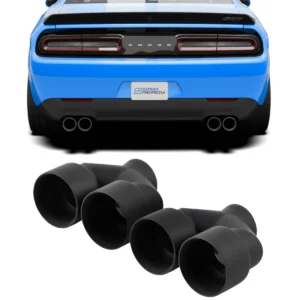
For the Charger, see the Dodge Charger 5-inch exhaust tips above. For the Challenger, our Dodge Challenger quad exhaust tips fit every 2017–2023 V8 Challenger and every 2015–2023 Hellcat, including the Widebody, Super Stock, Jailbreak and Demon. They clamp onto the factory tailpipes with the factory collar clamps, in about an hour.
GridReady product
Dodge Challenger Quad Exhaust Tips, 4 Inch Black
- Fits 2017–2023 V8 Challenger and 2015–2023 Hellcat, incl. Widebody, Super Stock, Jailbreak and Demon
- Ceramic-coated black over 304 stainless steel
- Bolt-on with the factory collar clamps, no cutting or welding required
FAQ
How much does a mid muffler delete cost?
On a Charger or Challenger, a bolt-on mid muffler delete kit costs about $50 to $200 if you fit it yourself. An exhaust shop usually charges $150 to $400 in total, either for cutting out the mid mufflers and welding in pipe, or for fitting a kit you bring along.
Is a mid muffler delete loud?
Yes, clearly louder than stock, but not as loud as a straight pipe. The rear resonators stay in place, so the car gets a deeper, louder sound with stronger cold starts and more crackle off the throttle, while the rear resonators still take the worst edge off at cruise.
Does a mid muffler delete add horsepower?
Only a little, usually a few horsepower, roughly 3 to 10 hp at most, and it is hard to feel on its own. You do it for the sound. The gains add up when it is combined with an intake, headers and a tune.
Does a mid muffler delete cause drone?
It can. Many cars get some boom in the cabin at highway cruising speed, and it is worse on automatic cars when the fuel saver mode runs the engine on four cylinders. Some drivers don’t mind it at all, others find it tiring on long trips.
Will a mid muffler delete cause a check engine light?
No. The mid mufflers sit well behind the catalytic converters and oxygen sensors, and the active exhaust valves are in the rear resonators, which stay. So there is nothing for the engine computer to miss.
Does a mid muffler delete void the warranty?
Not the whole warranty. In the US, a dealer can’t refuse warranty work just because you fitted an aftermarket part, but they can refuse to cover damage that the part caused, such as a rattle or leak in the exhaust you changed. Keep your stock mid mufflers so you can put them back if needed.
Is a mid muffler delete illegal?
It depends on your state. A mid muffler delete doesn’t touch the catalytic converters, so it isn’t an emissions problem, and the rear resonators still work as mufflers. But many states forbid changes that make the exhaust louder than stock, so a loud car can still get a noise ticket.
Why are Challenger mufflers called mid mufflers?
Because they sit in the middle of the car, under the passenger area, between the catalytic converters and the rear axle. The Challenger and Charger have a second pair of silencers at the back, the rear resonators, so the front pair is called the mid mufflers to tell them apart.
Can you do a mid muffler delete on a V6 Charger or Challenger?
You can, but we don’t recommend it. The 3.6 V6 has no deep V8 note to bring out, so removing silencers mostly makes it raspy and droney. On a V6, a cat-back made for the 3.6 sounds much better.





7 thoughts on “Dodge Charger and Challenger Mid Muffler Delete Guide: HP, Cost & Sound”