


Do Exhaust Tips Change Sound? Everything You Need to Know (2026)


Do exhaust tips change sound? Yes, but only a little. A new tip can make the note sound slightly fuller or deeper when you stand behind the car, and a resonated tip can take some rasp out. No tip will make a quiet car loud. The volume and character of your exhaust are set further forward, by the mufflers, resonators and pipes.
We make bolt-on exhaust tips for the Dodge Charger and Challenger, so we hear this question every week, usually from owners hoping a set of tips will give them a meaner sound for under $200. This guide gives you the honest answer: what a tip actually does, how much size, shape and resonated tips change the sound, why the change is so small, and which cheap mods do make a car louder if that is what you are after.
Will exhaust tips change sound? Yes, a little. Here is how much
Here is what each type of change does to your exhaust sound, from the smallest to the biggest, with rough US prices for parts.
| Change | What you hear | Louder? | Rough cost |
|---|---|---|---|
| Regular exhaust tips, same size | Almost nothing | No | $30–$250 |
| Bigger exhaust tips | Slightly fuller note behind the car | Barely | $50–$300 |
| Resonated exhaust tips | Less rasp, a touch deeper | No, slightly quieter | $80–$300 |
| Turndown tips | A bit quieter behind the car | No | $20–$80 |
| Mid-muffler or resonator delete | Clearly louder and deeper | Yes | $50–$400 |
| Axle-back or cat-back exhaust | Big change, tuned sound | Yes | $400–$2,500 |
| Muffler delete or straight pipe | Very loud, often drone | Very | $100–$600 |
So if you mainly want a new look, tips are the cheapest way to get it. If you mainly want a new sound, the money belongs further forward in the exhaust. Most owners end up doing both: the sound change first, then tips to finish the back of the car.
Exhaust tips for your Dodge
On the 2015–2023 Charger and Challenger, the factory tips sit deep inside big openings in the lower bumper, and they look small. Our tips are sized to fill those openings. They won’t change the sound much (no tip does), but they change the back of the car a lot.
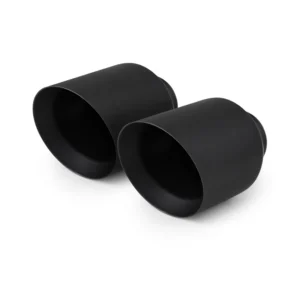
GridReady product
Dodge Charger 5-inch Black Exhaust Tips
- Fits 2017–2023 V8 Charger (R/T, Scat Pack, SRT) and the 2015–2023 Charger Hellcat
- Ceramic-coated black over 304 stainless steel
- Bolt-on with the factory clamps, no cutting or welding required
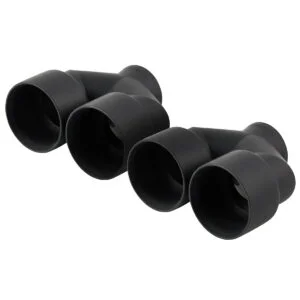
GridReady product
Dodge Challenger Black Quad Exhaust Tips
- Fits 2017–2023 V8 Challenger (R/T, Scat Pack, SRT) and the 2015–2023 Challenger Hellcat
- Quad look: two 4-inch outlets per side, left and right set
- Ceramic-coated black, bolt-on with the factory clamps
In this guide
- What exhaust tips do (and don’t do)
- Why a tip can only change the sound a little
- Do bigger exhaust tips make your car louder?
- Does the tip’s shape change the sound?
- Resonated exhaust tips: the one type that really changes the note
- Do dual or quad exhaust tips change the sound?
- Exhaust tips vs muffler delete vs straight pipe
- What we hear on a Charger and Challenger with our tips
- V6, 4-cylinder and trucks
- Will exhaust tips affect performance or mileage?
- Are exhaust tips worth it?
- FAQ
What exhaust tips do (and don’t do)
An exhaust tip is the short piece of pipe at the very end of your exhaust, the part you see under the rear bumper. On most cars it is held on with a clamp, slipped over the tailpipe, or welded on. It is the last part of the exhaust system and its components, after the catalytic converters, the resonators and the mufflers.
So what do exhaust tips do? Four things:
- Finish the look. This is the main job. A tip sets the size, shape and finish of what people see from behind, from small chrome to a big black outlet that fills the bumper.
- Keep heat and soot off the bumper. The tip carries the hot gas out past the paint and plastic, so the bumper doesn’t discolor or melt and soot doesn’t build up on it.
- Point the gas. Straight back, angled, or down at the ground (a turndown tip, common on trucks).
- Shape the sound a little. The outlet size, the shape and anything inside the tip can change the note slightly. The rest of this guide explains exactly how much.
What a tip does not do: add horsepower, fix drone, or turn a quiet exhaust into a loud one. And on many newer cars, the “tips” in the bumper are fake. They are plastic or metal trim with the real pipe hidden behind it, pointing at the ground. Changing that trim does nothing at all to the sound, so look under your car before you buy anything.

Why a tip can only change the sound a little
The sound of your exhaust starts in the engine. Every time a cylinder fires, it pushes a pulse of hot gas into the exhaust, and those pulses are the sound. On their way out, they pass through the catalytic converters, the resonators and the mufflers. Each of those parts is built to cancel or absorb part of the sound, and by the time the gas reaches the tip, almost all of its character has already been decided.
There is also a simple size problem. The deep rumble of a V8 cruising at about 1,800 rpm is a sound wave roughly 9 to 10 feet long. A tip is about a foot long and a few inches wide. A part that small, sitting at the very end of the pipe, can change how the sound leaves the car, but it can’t do much to the low notes you actually feel. It has a little more effect on the high notes (rasp and buzz), because those waves are much shorter.
That is why the honest answer to “will exhaust tips change sound” is always “a little”. The parts that decide your sound are the mufflers and resonators. On Mopar cars like the Charger and Challenger, the rear mufflers are usually called resonators, and the exhaust also has a mid muffler on each side. Those four cans do far more to the sound than any tip.
Do bigger exhaust tips make your car louder?
Not really. A bigger tip makes the car sound slightly fuller, not much louder. Here is what changes with the size of the tip:
| Tip compared to your pipe | What happens to the sound |
|---|---|
| Smaller outlet than the pipe (necked down) | Can sound a little raspier or whistle at high rpm. Avoid it. |
| Same size outlet as the pipe | No change you will hear. |
| Bigger outlet (for example a 3-inch pipe into a 5-inch outlet) | Slightly fuller, rounder note when you stand behind the car. Little or no change in volume, and none from the driver’s seat. |
The reason is how sound leaves the end of a pipe. A wider opening lets the lower notes leave the pipe a bit more easily, so the note behind the car sounds a touch deeper and rounder. But the exhaust gas still comes out of the same size pipe, through the same mufflers, so the overall volume barely moves.
Does exhaust tip size change sound?
Size changes the tone more than the volume. Going from a small factory tip to a much bigger outlet is about the most you can do with a regular tip, and even that is a small change. If you want to check for yourself, record a cold start and a rev with your phone from the same spot behind the car, before and after. Most people struggle to tell the two videos apart.
Size matters much more for the look. Our exhaust tips guide explains inlet and outlet sizes, how to measure your pipe and which size looks right on which car.
Does the tip’s shape change the sound?
A little, and less than most product pages suggest. Here is what each common shape does:
| Tip type | What it is | Effect on sound |
|---|---|---|
| Single wall | One layer of metal | Neutral. Very thin, cheap single-wall tips can buzz or ring at certain rpm. |
| Dual wall (double wall) | A second layer of metal around the outlet | Neutral to very slightly smoother, because the thicker tip doesn’t ring. Mostly a look. |
| Rolled edge | The end is rolled inward for a clean edge | None you will hear |
| Angle cut (slant cut) | The outlet is cut at an angle | Points the sound slightly sideways or down. Tiny effect. |
| Straight cut | Flat, square outlet | Points the sound straight back. Tiny effect. |
| Turndown | Short tip bent toward the ground | A bit quieter behind the car, because the sound hits the road first |
| Intercooled | Rolled-edge tip with slots or vanes around the inner tube | None you will hear. It is a style. |
| Resonated | Perforated inner tube with sound-absorbing packing | Less rasp, slightly deeper, slightly quieter. The only type with a real effect. |
Tips sold as “sound amplifying” can’t make your exhaust louder. A tip can only pass on the sound that reaches it. Whistle tips do add a noise, but it is a whistle, not a better exhaust note.
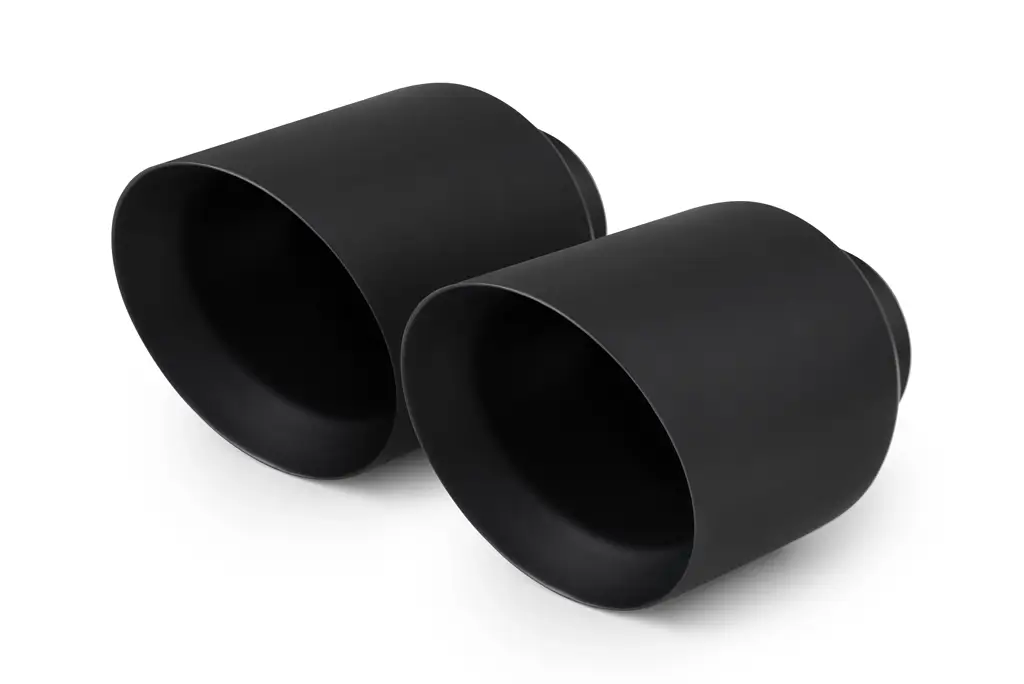
Resonated exhaust tips: the one type that really changes the note
A resonated tip has a perforated inner tube with heat-proof packing around it, like a tiny glasspack muffler at the end of the pipe. The packing soaks up some of the high notes, so the car sounds less raspy and a little deeper. Because it absorbs sound, it makes the car slightly quieter, not louder.
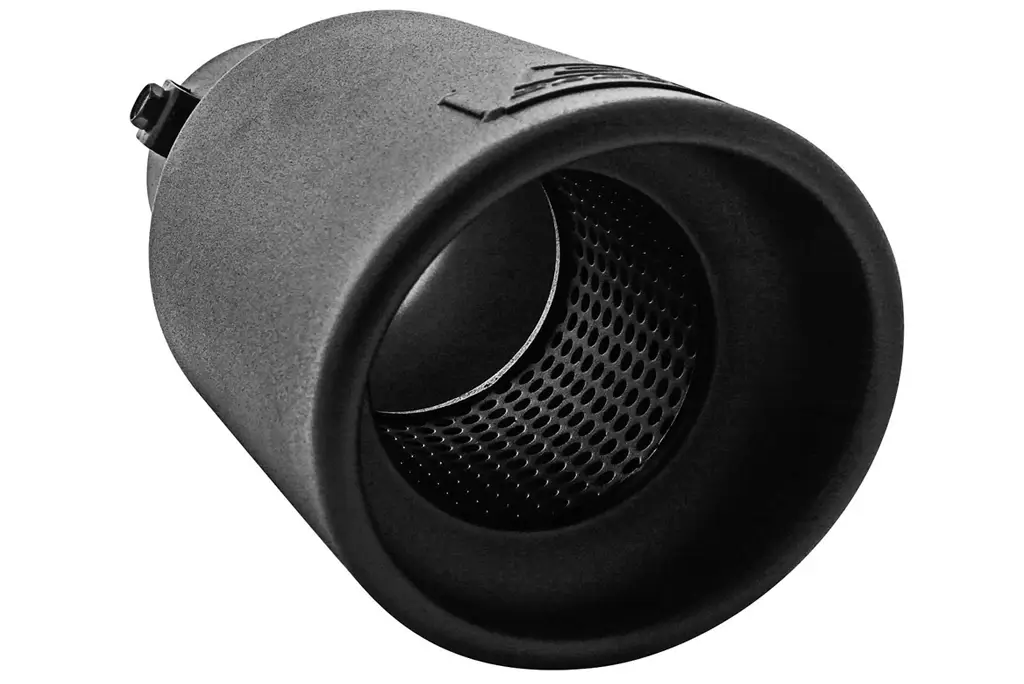
What it can’t do is stop drone, the steady boom inside the car on the highway. Drone is a low note, and a few inches of packing can’t absorb it. Resonated tips make the most sense on a raspy car, such as a V6 or a 4-cylinder with a louder aftermarket exhaust. On a stock Hemi there is very little rasp to remove.
We cover them in detail, including how to spot a fake “resonated” tip with no packing inside, in our guide to what a resonator exhaust tip does.
Do dual or quad exhaust tips change the sound?
Mostly no. A dual tip that splits one pipe into two outlets, or a quad setup with two outlets per side, sends the same gas from the same pipes out through more openings. You may hear a slightly softer, wider note behind the car, but the volume and character stay the same.
A real dual exhaust is different. If a car goes from one pipe to two separate pipes (a full dual exhaust system), the sound does change, because the exhaust itself has changed. The tips at the end are not what makes that difference.
Exhaust tips vs muffler delete vs straight pipe: what moves the needle
If you want a louder or deeper car, these are the changes that actually work, from cheapest to most expensive.
Mid-muffler or resonator delete
A shop cuts out a muffler or resonator and welds in a straight pipe, or you bolt in a delete pipe. It is the cheapest real sound change: clearly louder and deeper, with some drone on the highway. On the V8 Charger and Challenger, removing the mid mufflers is the most popular first step, and our mid-muffler delete guide for the Charger and Challenger covers cost and sound.
Muffler replacements
Swapping the stock muffler for a performance muffler gives you more sound without going all the way to a delete. A straight-through or chambered muffler from a brand like Flowmaster, MagnaFlow or Borla lets you choose how loud and how deep you want it. A full muffler delete is cheaper but much louder, and on most cars it brings drone and rasp with it.
Cat-back and axle-back systems
An axle-back replaces the mufflers and pipes behind the rear axle. A cat-back replaces everything from the catalytic converters to the tips. Both are engineered as a set, so you get a planned sound instead of whatever a delete gives you. Borla, Corsa and MagnaFlow are the brands we see most on Chargers and Challengers. Expect roughly $400 to $1,200 for an axle-back and $700 to $2,500 for a cat-back, plus fitting if you don’t do it yourself.
Headers and mid-pipes
Headers replace the exhaust manifolds at the engine, and mid-pipes (X-pipes and H-pipes) change how the two sides of a V8 meet. They change the sound the most and add the most power, especially with a tune. They also cost the most and can affect emissions, so check your state’s rules first. American Racing Headers, Kooks and Stainless Works are well-known names here.
Straight pipe
Removing all mufflers and resonators gives you the loudest result, and usually a lot of drone and rasp. Our straight pipe exhaust guide explains the cost, the legal side and what it does to your car.
Every one of these options keeps your factory tips. That is the honest place for new tips: once the sound is the way you want it, tips finish the look.
What we hear on a Charger and Challenger with our tips
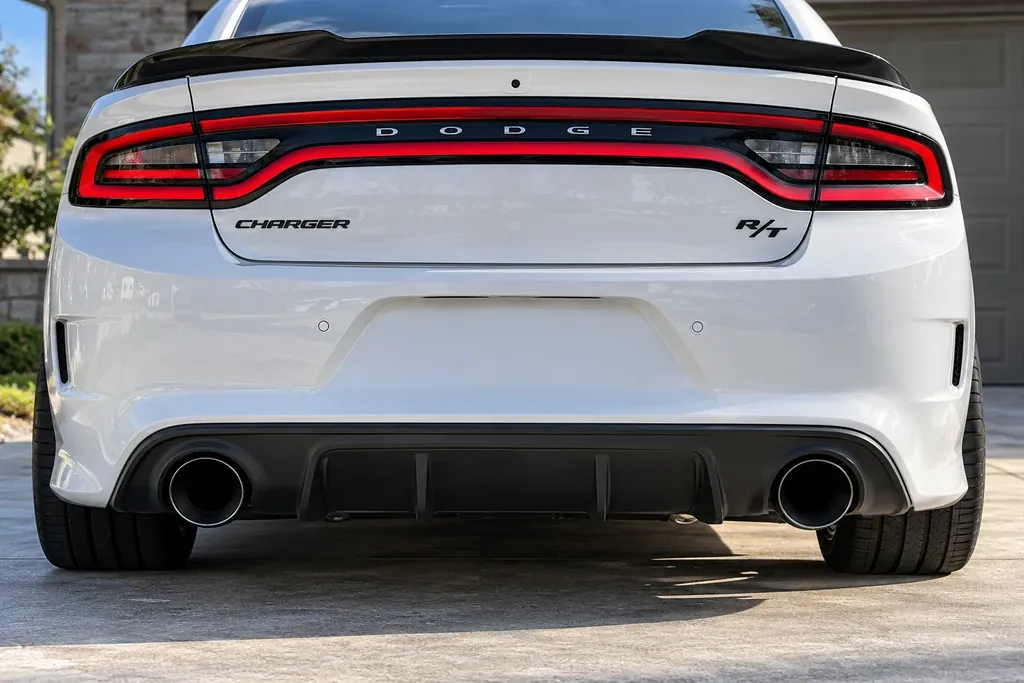
On the 2017–2023 V8 Charger, the factory tips are short pieces held on with collar clamps, sitting inside a big round opening on each side of the lower bumper. Our 5-inch tips bolt on with the same clamps and fill those openings. Every time we fit a set, the result is the same:
- From behind the car: the note sounds a touch fuller at idle and on a rev, because of the bigger outlet.
- From the driver’s seat: no difference.
- Active exhaust: the valves in the rear resonators work exactly as before. Track and Sport modes sound the same.
- The look: a big change. The back of the car finally looks finished.
The Challenger is the same story with a wider bumper. Our quad tips split each side into two 4-inch outlets to fill the long openings in the rear valance. Sound change: small. Visual change: large. Both sets fit the V8 cars only. The V6 SXT and GT have a different bumper without the round tip openings, so V8 tips don’t fit them.
If you want more sound on these cars, do it in this order: decide on the exhaust first (stock, a mid-muffler delete or a cat-back), then add tips. Most of those options keep the small factory tips, and that is exactly the gap our 5-inch black exhaust tips for the V8 Charger and quad exhaust tips for the V8 Challenger fill.
Do exhaust tips change the sound on a V6, a 4-cylinder or a truck?
- V6 (for example the 3.6 Pentastar): very little change with a regular tip. With a louder aftermarket exhaust, a resonated tip can take some rasp out, which is one of the few cases where tips help the sound.
- 4-cylinder and turbo cars: the same. Turbos already quiet the exhaust, so tips change the sound even less. A resonated tip can tame a raspy aftermarket setup.
- Trucks: a big tip on a truck changes the look and very little else. A turndown tip makes the truck slightly quieter behind it and keeps fumes away from the tailgate. On diesels, the sound is mostly set by the turbo and the exhaust aftertreatment, so tips do almost nothing.
Will exhaust tips affect performance or mileage?
No. A tip sits after every part that matters for flow, and as long as its inlet matches your pipe, it doesn’t add or remove any restriction. You won’t gain horsepower, you won’t lose torque and your gas mileage stays the same. The only exception is a tip that is narrower than the pipe, which can add a small restriction. Avoid those.
Tips also don’t affect emissions or a smog check, and a bolt-on tip won’t void your warranty. Under the Magnuson-Moss Warranty Act, a dealer has to show that an aftermarket part caused a problem before refusing a repair, and a tip at the end of the pipe can’t cause much.
Are exhaust tips worth it?
For the look, yes. Tips are the cheapest way to change the back of a car, and a bolt-on set goes on in about an hour with basic tools. They are especially worth it if your factory tips are small, dull or sit deep inside a big bumper opening.
For the sound, no. If sound is the main reason you are shopping, spend the money on the exhaust itself first. Tips will polish the result, but they are not what builds it.
FAQ
Do exhaust tips make a car louder?
Barely. A bigger outlet can make the note sound slightly fuller behind the car, but the volume hardly changes and you won’t hear a difference from the driver’s seat. To make a car louder, change the mufflers or resonators.
What do exhaust tips do for a car?
They finish the look of the exhaust, carry the hot gas past the bumper so it doesn’t get damaged or sooty, and point the gas in a set direction. They can change the tone a little, but they don’t add power or make the car much louder.
Are bigger exhaust tips louder?
Not really. A bigger tip changes the tone more than the volume: the note sounds a bit fuller and rounder when you stand behind the car. The volume is set by the mufflers, resonators and pipe size, not the tip.
Do resonated tips make the exhaust louder or deeper?
A little deeper, not louder. The packing inside absorbs some of the high, raspy notes, so what is left sounds lower and smoother, and slightly quieter. They don’t fix drone.
Do exhaust tips change the sound on a V6?
Very little. On a stock V6 you won’t hear much difference. On a V6 with a louder aftermarket exhaust, a resonated tip can make the rasp a bit softer.
Do dual or quad exhaust tips change the sound?
Not much. Splitting the same pipe into two outlets can make the note sound slightly softer and wider behind the car. A real change only comes from a full dual exhaust with separate pipes.
Do exhaust tips affect performance or gas mileage?
No. As long as the tip’s inlet matches your pipe, it adds no restriction, so power, torque and gas mileage stay the same.
What exhaust tips are loudest?
No tip makes a car much louder. A large, straight-cut tip pointing straight back projects the sound best. Resonated and turndown tips are the quietest, because they absorb sound or point it at the ground.
One thought on “Do Exhaust Tips Change Sound? Everything You Need to Know (2026)”