


Dodge Challenger Mods & Accessories Guide (2015–2023): Cheap, Easy and Worth It

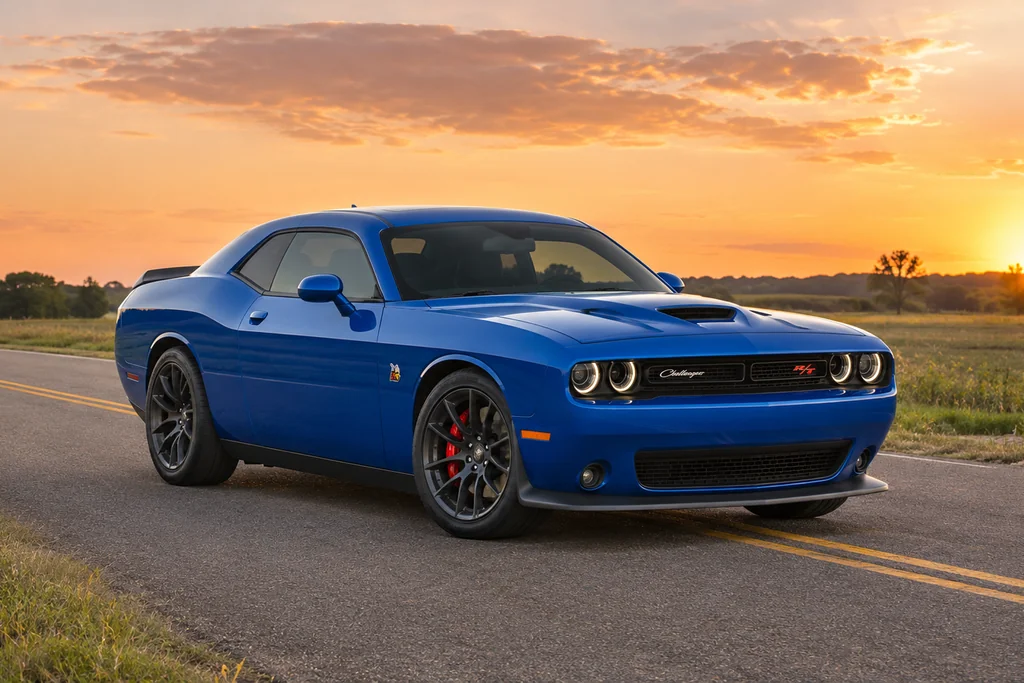
Looking for the best Dodge Challenger mods? We design and sell parts for the 2015–2023 Challenger, so we spend a lot of time around these cars and answering questions about them. In this guide we go through the upgrades we would recommend to a friend who just bought one: what fits which trim, what each mod costs, and which ones are really worth it.
Everything here is for the 2015–2023 Challenger (the facelifted car with the LED halo headlights). The 2008–2014 cars use different lights and some different parts.
In this guide
- Trims and years: what you are starting with
- Cheap Challenger mods under $50
- Mods under $200
- Challenger exterior mods
- Challenger interior mods
- Everyday Dodge Challenger accessories
- Exhaust mods
- Tires, suspension and brakes
- Challenger horsepower mods
- Three Challenger builds and what they cost
- Dodge Challenger mods by trim
- What to avoid
- Our Dodge Challenger accessories
- FAQ
Trims and years: what you are starting with
Your trim decides how much power you start with and which mods give you the most for your money. Find your car in this table first. The power figures are Dodge’s own ratings.
A few things that matter for mods:
- Widebody: Dodge offered the Widebody package on the SRT Hellcat from 2018 and on the R/T Scat Pack from 2019. The fender flares make the car 3.5 inches wider, so Widebody cars run wider wheels and tires, and some body parts (like side markers) differ from the standard car.
- Manual or automatic: the R/T, Scat Pack, SRT 392 and Hellcat were offered with a 6-speed manual. The V6 cars are automatic only.
- Demon: the 2018 SRT Demon and the 2023 SRT Demon 170 were limited-production drag cars. They are built for the drag strip straight from the factory, so we leave them out of the power advice below.
The engine is what decides the plan. On a V6 Challenger, the mods worth doing are about looks, comfort and grip. On a V8, sound and power mods start to pay off too. Lighting, vinyl and interior mods fit every trim from SXT to Hellcat.
Cheap Challenger mods under $50
These are the mods we recommend first. They change how the car looks or feels every day, cost very little and can all be undone.
Headlight eyelids (“angry eyes”)
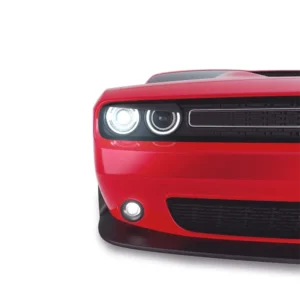
The Challenger’s four round headlights with their LED halo rings are the face of the car. Headlight eyelids are thin covers that sit along the top of the headlight bezels and give the lights a lowered, squinting look. This is the “angry eyes” (or “devil eyes”) look, and it makes the front of the car look meaner without changing the headlights themselves. For the price, we think it is the biggest change you can make to the front of a Challenger.
Our headlight eyelids for the 2015–2023 Challenger fit every trim, from SXT to Hellcat, including Widebody cars. They stick to the headlight bezels with automotive-grade adhesive, so there is no drilling or cutting, and the factory headlights stay untouched. Clean the bezel with rubbing alcohol first, fit them on a warm day (or warm the area with a hair dryer), and press them down firmly. They are made for the 2015–2023 headlights, which Dodge redesigned for the 2015 refresh, so they are not made for the 2008–2014 car.
GridReady product
Dodge Challenger Headlight Eyelids
- Fits every 2015–2023 Challenger trim, SXT to Hellcat, incl. Widebody
- The “angry eyes” look for the quad halo headlights
- Sticks to the headlight bezels, no drilling or cutting
Tail light, side marker and reflector tint
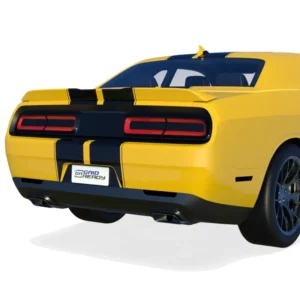
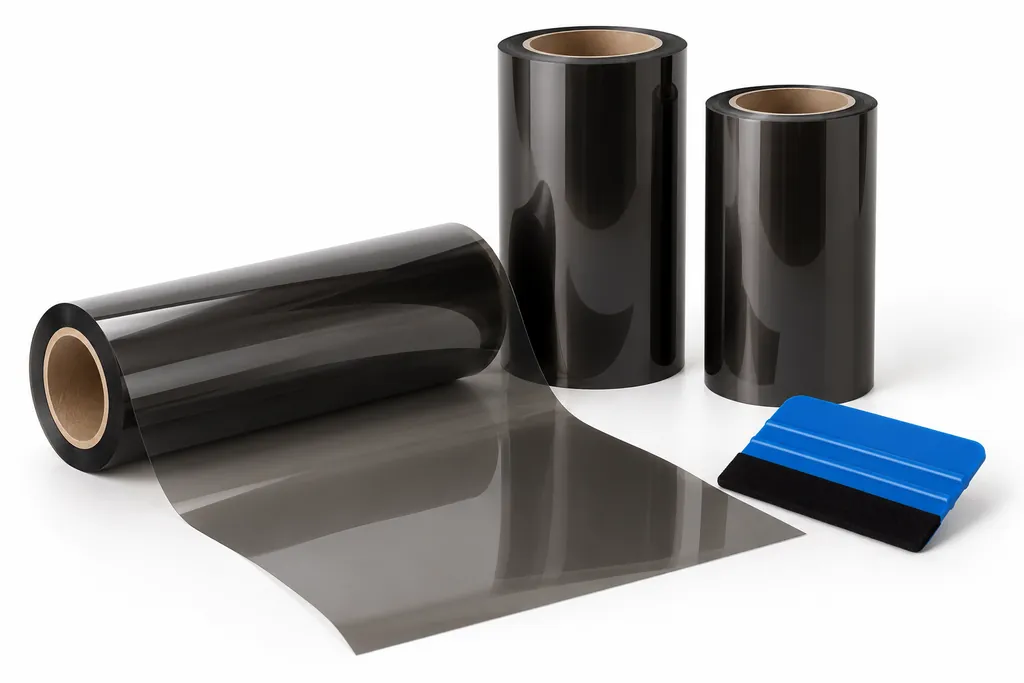
Tinting the tail lights dark gives the back of the Challenger a blacked-out, finished look. On this car there is a catch most kits ignore: the amber front side markers, the red rear side markers and the rear reflectors stay bright, and they stand out once the tail lights are dark. Our pre-cut tail light tint for the 2015–2023 Challenger covers the tail lights, the side markers and the rear reflectors in the same dark smoke, so the whole car matches.
The kit goes on dry, with the lights on the car, in about 30 minutes, with no cutting required. Our vinyl has air-release channels (not every brand does), so the air escapes as you squeegee and you don’t need water or spray. That is why we only make dry install kits: wet install film is usually the cheaper, thinner kind, while dry vinyl is easier to get right and lasts longer. It can be removed easily if you want to go back to stock. On a Widebody, the tail light and rear reflector pieces fit, but the side marker pieces only fit the standard body. If you want the full comparison of film, spray and pre-cut vinyl, our tail light tint guide covers it.
GridReady product
Dodge Challenger Tail Light Tint
- Tail lights, side markers and rear reflectors for every 2015–2023 Challenger
- Pre-cut dark smoke vinyl, dry install with air-release channels
- Squeegee, towel, practice pieces and install instructions included
Tail light and side marker tint rules differ by state, and a few states are strict about how dark a light can be. It is worth a quick look at the tail light tint laws by state before you go dark. This is not legal advice, and the rules change.
Extended paddle shifters
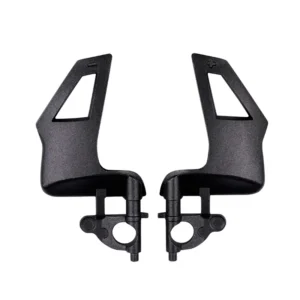
The factory paddles on the Challenger are small and sit far back from the rim, so it is easy to miss one mid-corner. Extended paddles are longer, so you can reach them without moving your hands on the wheel. It is the cheapest mod that changes how the car feels to drive, not just how it looks.
They fit every trim, as long as your car came with paddles from the factory. Our extended paddle shifters for the 2015–2023 Challenger replace the factory paddles in 15 to 30 minutes. You remove the screws with the included tool, swap the paddles and tighten the screws again, with no airbag removal and no wiring.
GridReady product
Dodge Challenger Paddle Shifters
- Fits 2015–2023 Challengers with factory paddles, all trims incl. Widebody
- Direct replacement, no airbag removal
- Majestic Black powder coat, tools included
Other small things under $50
- Badge blackout: vinyl overlays or a peelable coating such as Plasti Dip for the grille, fender and trunk badges. Cheap, but take your time, because a badly cut badge looks worse than chrome.
- LED interior bulbs: if your dome and map lights still use regular bulbs, LED replacements from brands like Diode Dynamics or Sylvania cost a few dollars each and make the cabin brighter and whiter.
- Phone mount: a mount made for the Challenger’s dash, from a brand like ProClip, keeps your phone at eye level instead of in the cupholder.
Mods under $200
These cost a bit more but still change the car a lot. Exhaust tips and a mid-muffler delete are for V8 cars. Window tint, floor mats and a catch can make sense on most Challengers.
Quad exhaust tips (V8)
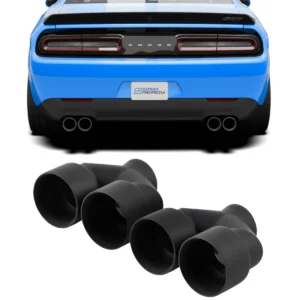
On a V8 Challenger, the exhaust openings in the rear valance are big, and the factory tips can look plain inside them. Black quad tips fill the openings and give the rear the same blacked-out look as tinted tail lights. Our black quad exhaust tips for the 2017–2023 V8 Challenger have two 4-inch outlets per side and fit the R/T, R/T Scat Pack, T/A and SRT 392 (Widebody cars included), plus every 2015–2023 Challenger Hellcat, Redeye, Super Stock, Jailbreak and SRT Demon. They don’t fit other 2015–2016 V8 cars or the V6, which has its tips built into the bumper.
Fitting them is a driveway job of about 1 hour. Each factory collar clamp has a small spot weld that you grind off with an angle grinder, then you loosen the clamp, slide the stock tip off, slide ours on and tighten the same clamp. There is no cutting or welding of the pipes, and your exhaust sound stays the same.
GridReady product
Dodge Challenger Quad Exhaust Tips, 4 Inch Black
- Fits 2017–2023 V8 Challenger and 2015–2023 Hellcat, incl. Widebody, Super Stock, Jailbreak and Demon
- Ceramic-coated black over 304 stainless steel
- Bolt-on with the factory collar clamps, no cutting or welding required
Other mods under $200
- Mid-muffler delete (V8): the mid mufflers under the middle of the car are swapped for straight pipes. Parts usually cost around $100 to $200, plus labor if a shop fits them. It is the cheapest way to get more Hemi sound, and it keeps the catalytic converters. More in the exhaust section.
- Oil catch can (V8): a catch can sits in the crankcase ventilation line and collects oil vapor before it reaches the intake. On a Hemi, it helps keep the intake cleaner. Kits from Mishimoto or UPR usually cost around $100 to $200.
- Window tint: a tint shop usually charges from about $150 to $200 for the side and rear windows with basic film, and more for ceramic film from brands like 3M, LLumar or XPEL. It keeps the cabin cooler and changes the look a lot. Check your state’s limits first.
- All-weather floor mats: WeatherTech and Husky Liners make fitted mats for the Challenger, usually from about $100 to $200 a set. Not exciting, but they keep the carpet looking new, which helps at resale.
Challenger exterior mods: eyelids, tint, stripes, splitters and blackout
The Challenger already looks like a muscle car from the factory, so the best appearance mods make it look finished rather than busy. Our rule of thumb: pick one theme (usually black accents) and stick to it.
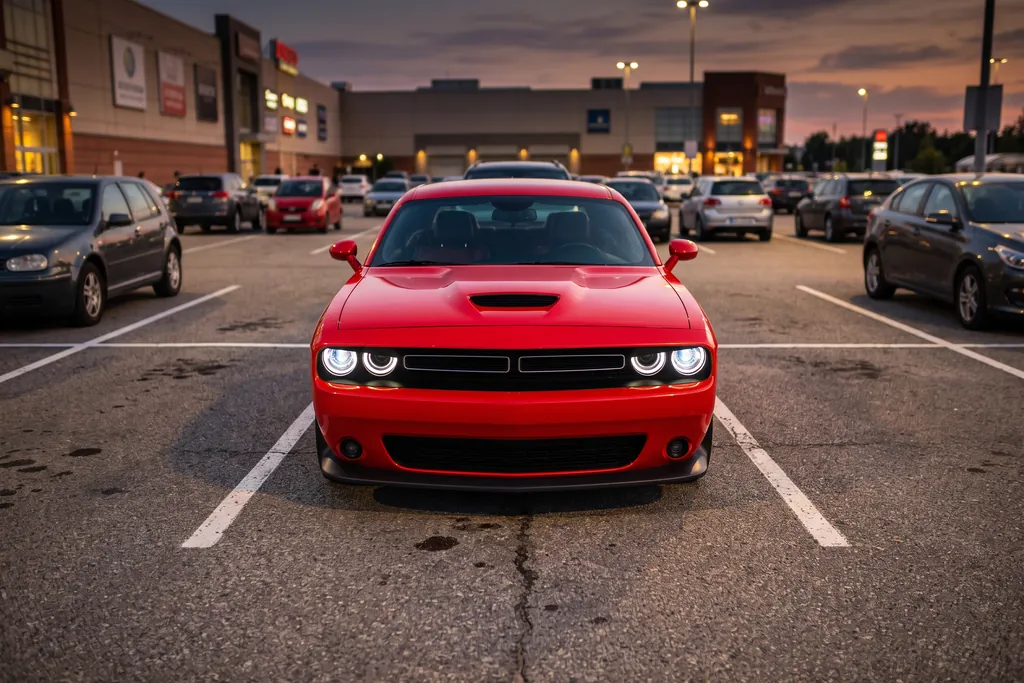
- Headlight eyelids: the quickest way to change the front of the car. We cover them in the under $50 section, together with our tint kit for the tail lights, side markers and reflectors.
- Stripes and decals: the Challenger wears stripes well. Dodge offered factory stripes in many styles, and aftermarket kits copy them or add your own design. Pay for a kit printed on good vinyl from 3M or Avery Dennison, and have a wrap shop fit large stripes if you have never laid big pieces of vinyl before.
- Blackout: badges, the grille surround, window trim (a chrome delete wrap) and a gloss black roof wrap. A black roof looks great on light colors like white, silver and yellow.
- Spoilers: the SXT and R/T come with a small body-color spoiler. A larger SRT style or ducktail spoiler from Mopar is a popular bolt-on. Buy one pre-painted to your paint code, or budget for paint.
- Front splitters and side skirts: they make the car look lower without lowering it. Cheap ones crack on the first steep driveway, so pay a bit more for a flexible material and drive carefully. Mopar, Extreme Dimensions and Anderson Composites (carbon fiber) are common names.
- Hoods: a Hellcat style or Shaker style hood is a popular swap on the plainer trims. It is a big job and a big cost, so make sure the hood is made for your year.
- Wheels: the biggest exterior change and the most expensive. A good set of 20-inch wheels with tires usually runs from about $1,500 to well over $3,000. Mopar’s own wheels, Weld and Forgestar are popular choices.
You can see every exterior and interior part we make for the car on one page: our Dodge Challenger accessories.
Challenger interior mods: paddle shifters, shifters, lighting and trim
You spend more time looking at the inside of your Challenger than the outside, so interior mods are worth more than people think.
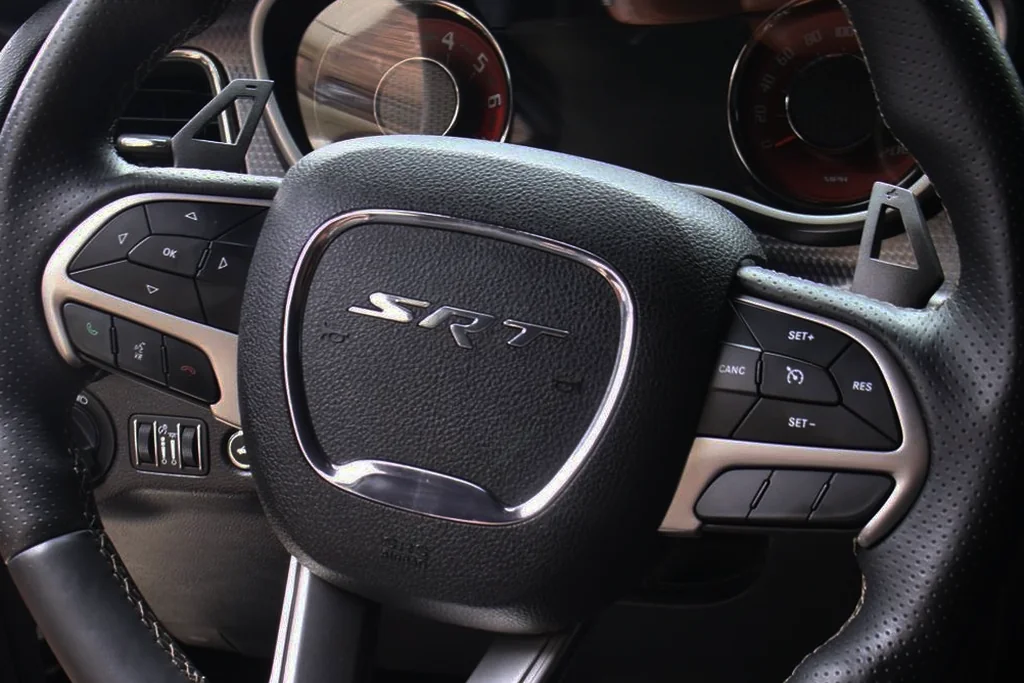
- Paddle shifters: if your Challenger has factory paddles, our extended Challenger paddle shifters are the best interior mod for the money. More about the fit and install in the under $50 section.
- Shifter (manual cars): on manual Challengers, a short-throw shifter from Barton or Hurst cuts the distance between gears and makes shifts feel tighter. Expect around $300 to $500.
- Shift knob (automatic cars): the automatic shifter has a release button and electronics inside, so a universal screw-on knob won’t fit. Only buy knobs or covers made for this exact shifter.
- Interior lighting: LED bulbs for the dome and map lights, and footwell LED strips. Keep it subtle and hide the wires. Bright colors that you can see from outside look cheap and can be illegal while driving in some states.
- Trim: carbon fiber look or color-matched overlays for the dash and console. Real carbon fiber trim was a factory option on several trims. Vinyl overlays cost a lot less, and from the driver’s seat most people can’t tell the difference.
- Seat covers and mats: fitted seat covers protect cloth seats on a daily driver. Pair them with the all-weather mats from the under $200 section.
Everyday Dodge Challenger accessories
Not every upgrade has to be a mod. These Dodge Challenger accessories protect the car and make it nicer to live with every day, and every one of them fits any trim.
- Car cover: an indoor cover keeps dust off in the garage, and an outdoor cover protects the paint from sun, rain, tree sap and bird droppings. Choose one made for the 2015–2023 Challenger shape (Widebody cars need a Widebody cover) with a soft inner lining, so it can’t scratch the paint. Covercraft, Coverking and Mopar make fitted covers, usually from about $150 to $400.
- Windshield sunshade: the Challenger has a big, steeply raked windshield and a dark dash, so the cabin heats up fast in the sun. A custom-fit shade from WeatherTech or Covercraft covers the whole glass and usually costs about $50 to $100.
- Paint protection film: a clear film on the front bumper, hood and mirrors stops stone chips before they reach the paint. XPEL and 3M are the common brands, and a shop usually charges about $1,000 to $2,000 for the front of the car.
- Emblems and badges: black or color-matched Challenger, R/T, Scat Pack or SRT badges are an easy way to make the car yours. Check that the new badge is the same size as your factory one, so it covers the same spot. Mopar sells factory emblems, and many vinyl shops make overlays.
- Full color-change wrap: the biggest look change you can still undo. Expect about $3,000 to $5,000 at a good shop for a car the size of a Challenger, and more for chrome or color-shift films. 3M 2080 and Avery Dennison SW900 are the films most shops use, and the wrap protects the factory paint underneath, which helps at resale.
- Trunk liner: a fitted liner from WeatherTech or Husky Liners keeps the trunk carpet clean from groceries, gym bags and track day gear.
- Key fob cover: a silicone or leather cover protects the key fob from scratches and drops, and some come in your paint color. They usually cost under $20.
Exhaust mods: quad tips, mid-muffler delete, cat-back
On a V8 Challenger, exhaust mods are the most popular upgrade after looks. Think of it as a ladder, from cheapest to most expensive:
- Mid-muffler delete. The mid mufflers under the middle of the car are replaced with straight pipes. You get more sound at a low cost, plus some drone at highway speed. Our Challenger and Charger mid-muffler delete guide covers cost, sound and legality.
- Resonator delete. The rear resonators (mufflers) at the back of the car are removed or swapped for straight pipes. It is louder again, and highway drone becomes more likely. Our article muffler delete: good idea or not explains the trade-offs.
- Cat-back system. Everything from the catalytic converters back is replaced. Borla, Corsa, MagnaFlow, Flowmaster and Mopar all make systems for the Challenger, usually from about $1,000 to over $2,000. Borla and Corsa are known for controlling drone, and MagnaFlow and Flowmaster are often a bit cheaper. This is the right choice if you want a big sound change that stays comfortable on long drives.
- Exhaust tips. A mid-muffler or resonator delete keeps the stock tips. New tips finish the job and change the look of the rear. Many cat-back systems come with their own tips, so check that before you buy both.
On a V6 Challenger: the SXT and GT have their tips built into the rear bumper and a much quieter exhaust. A cat-back or axle-back system for the V6 from Borla, MagnaFlow or Flowmaster gives it a deeper sound, usually for about $500 to $1,200. It won’t make a V6 sound like a Hemi, but it takes away the plain stock tone.
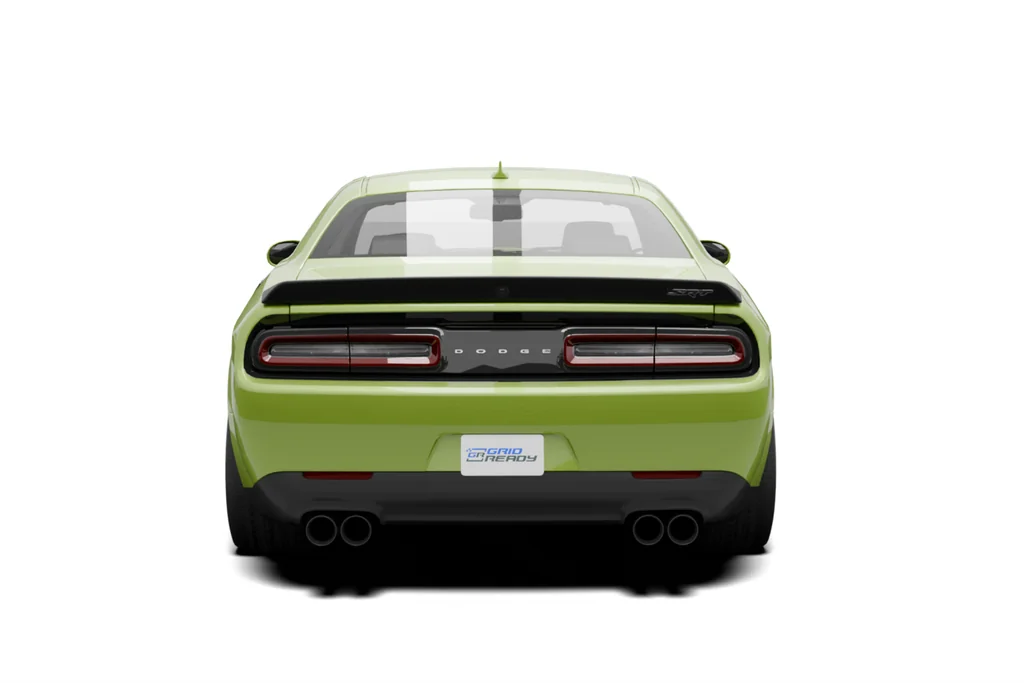
Whichever of these you choose, our black quad tips for the V8 Challenger bolt on with the factory collar clamps (more in the under $200 section). Tips on their own change the look, not the sound, and our article on whether exhaust tips change the sound explains why. If you are still choosing a size or finish, our exhaust tips guide covers how to pick.
The Challenger shares its Hemi engines with the Charger, so the sound comparison in our Dodge Charger exhaust guide is a good preview of what each option sounds like on your car too. A full straight pipe is the loudest option of all, and on a street car we don’t recommend it.
Tires, suspension and brakes
The Challenger is a big, heavy car, roughly two tons, and that shows up the moment you add power. These Dodge Challenger upgrades make it quicker in the real world, even though they add no horsepower.
- Tires first. Every V8 Challenger can spin its rear tires. Good summer tires, such as the Michelin Pilot Sport 4S or Continental ExtremeContact Sport, make the car faster and safer than any bolt-on. For drag strip launches, a street-legal drag radial like the Nitto NT555RII or Mickey Thompson ET Street S/S on the rear works much better.
- Wider rear tires: a wider rear wheel and tire is one of the most popular Challenger mods for traction. Check the bolt pattern (5×115 on the 2015–2023 Challenger) and the offset before you buy, so the tire clears the fender.
- Lowering springs: springs from Eibach, H&R or Mopar drop the car around an inch or two, close the gap above the tires and cut some body roll. They cost a few hundred dollars plus an alignment.
- Sway bars: thicker anti-roll bars from Hotchkis or Eibach make the car feel smaller in corners. A good mod if you drive on twisty roads.
- Brakes: more power means more heat. Fresh performance pads (Hawk and EBC are popular) and good brake fluid come before boost. SRT and Scat Pack cars already come with Brembo brakes from the factory.
Challenger horsepower mods: what works on each engine
This is the question we get asked most about the V8 cars. On a stock Challenger, single bolt-on parts add less power than the boxes claim. Real gains come from combining parts with a tune, or from adding boost. The numbers below are typical gains at the engine. On a dyno at the wheels, expect a bit less.
Tuning a 2015–2023 Challenger
The tune is what makes most power mods work, because the engine computer has to be told about the new parts. On most 2015 and later Challengers the engine computer is locked from the factory, so it has to be unlocked, or swapped for an unlocked one, before a handheld tuner or a custom tuner can write to it. Budget a few hundred dollars for that on top of the tuner. A custom tune on a dyno costs more than a ready-made handheld tune but gets more out of your exact setup.
V6 (SXT, GT): keep expectations low
The 3.6 Pentastar is a reliable engine, but it was not built for power mods. An intake, a tune and a cat-back together usually add somewhere around 15 to 25 hp, and you will notice the sharper shifts from the tune more than the power. Supercharger kits for the V6 exist but are rare and expensive. We recommend spending on tires, brakes and looks, and if you want real speed, moving up to a V8 will always cost less than making a V6 fast.
R/T (5.7 Hemi): intake, tune, exhaust
The classic R/T route is an intake, a tune and a cat-back or mid-muffler delete. Together that is typically 25 to 35 hp, and the car feels much livelier because the tune also sharpens the factory throttle. If your R/T has the Shaker hood, you already have a cold air intake, so go straight to the tune. After that, the next real step is a cam or a supercharger. Once you price those, a Scat Pack often works out cheaper, so it helps to decide early how far you want to go.
Scat Pack and SRT 392 (6.4 Hemi): tune and headers
The 392 responds best to an intake, long tube headers and a tune, which together often add 40 to 60 hp. Headers are the expensive part, and in strict emissions states they can mean a failed inspection. Beyond that, a cam or a supercharger kit takes a Scat Pack into Hellcat territory, at Hellcat-level cost.
Hellcat, Redeye and Jailbreak (6.2 supercharged): pulley and tune
On a supercharged engine, a smaller upper pulley spins the supercharger faster for more boost. With a tune, that is one of the cheapest big power gains on any car. E85 fuel with the right fuel system adds more again. The catch is that a stock Hellcat already struggles to put its power down, so tires, and later the fuel system and driveline, need to keep up.
Three Challenger builds and what they cost
A modded Challenger doesn’t have to mean a big bill. Here is what the upgrades in this guide add up to, from a weekend refresh to a full build. Prices are rough US street prices for parts, before any shop labor.
The under $75 refresh (any trim)
Headlight eyelids, tail light tint and extended paddle shifters (if your car has paddles). All three of ours together come in under $75. The front looks meaner, the back and sides look blacked out, and the paddles are easier to reach. You can fit all three on a Saturday with the tools that come in the kits. This is where we would start on any Challenger, because you see the difference every time you walk up to the car.
The $500 weekend build (V8)
Everything in the refresh, plus black quad exhaust tips and a bolt-on mid-muffler delete kit. Now the car looks finished from every angle and sounds the way a Hemi should. Budget a little extra if a shop fits the mid-muffler delete. On a V6, put that money into window tint and a good set of tires instead.
The $3,000+ full build (R/T or Scat Pack)
The weekend build, plus wheels and summer tires, a cat-back exhaust from Borla, Corsa or MagnaFlow in place of the mid-muffler delete, and lowering springs. This is the point where the car looks, sounds and drives very differently from stock. It is also a good place to stop and enjoy it, because the next step (a tune with headers, or a supercharger) costs a lot more for each extra smile.
Whatever your trim and budget, we recommend the same order: the looks you see every day, then sound, then grip, then power. If you start with power, you usually end up buying tires twice.
Dodge Challenger mods by trim: the best first mods for an SXT, R/T, Scat Pack and Hellcat
What to avoid: warranty, legality and resale
Warranty
Fitting aftermarket parts does not void your whole warranty. Under the federal Magnuson-Moss Warranty Act, the dealer has to show that your part caused the problem before they can refuse a repair, and the rest of the car stays covered. The FTC explains this in its guide to auto warranties. In practice, eyelids, tint, paddles and tips cause no trouble. Tunes are different: a tuned engine that fails will usually be looked at very closely, and a dealer can often see that the engine computer was changed.
Legality
- Lights: tail light, side marker and window tint limits vary by state. Very dark tint can get you a ticket in strict states.
- Exhaust: many states have noise limits, and removing the catalytic converters is illegal on road cars everywhere in the US. A mid-muffler delete keeps the cats.
- Emissions: tunes and headers are the mods most likely to fail an emissions test. In California and other strict states, look for parts with a CARB EO number.
Resale
Buyers usually pay more for a clean, mostly stock Challenger, and that goes double for a Hellcat or a special edition. Keep your factory parts in a box, choose mods you can undo, and keep receipts. Vinyl, eyelids, tips and paddles all come off quickly if you want to sell the car stock.
Our Dodge Challenger accessories
Everything we make for the 2015–2023 Challenger is on one page: Dodge Challenger parts and accessories from GridReady. Right now that is four parts:
- Headlight eyelids for the “angry eyes” look, every trim.
- Tail light tint with the side markers and rear reflectors included, every trim.
- Extended paddle shifters for cars with factory paddles.
- Black quad exhaust tips for the 2017–2023 V8 and every 2015–2023 Hellcat.
If you were looking for Dodge’s own accessories catalog, factory Mopar accessories are sold through Dodge dealers. All of them bolt on or stick on, all of them can be undone, and we ship free in the US. Not sure what fits your car? Send us a message with your year and trim before you order, and we will check it for you.
Related guides
- Dodge Charger mods and accessories guide
- Tail light tint explained: film vs spray vs pre-cut vinyl
- Resonator exhaust tips: what they do
FAQ
What are the best first mods for a Dodge Challenger?
Headlight eyelids, tail light tint and extended paddle shifters. They are cheap, change how the car looks and feels every day, and can be undone. On a V8 Challenger, add exhaust tips, a mid-muffler delete and good summer tires next.
What are cheap mods for a Challenger?
Headlight eyelids, tail light tint, extended paddle shifters, badge blackout and LED interior bulbs all cost under $50. Each one takes an hour or less to fit.
Do headlight eyelids fit all Challengers?
Ours fit every 2015–2023 Challenger trim, from the SXT to the Hellcat, including Widebody cars. They are made for the headlights Dodge introduced with the 2015 refresh, so they are not made for 2008–2014 Challengers.
Can you mod a V6 Challenger?
Yes. Headlight eyelids, tail light tint, paddle shifters (on cars with factory paddles), wheels, tires and interior mods all fit the SXT and GT. Power mods add very little on the 3.6 V6, and V8 exhaust parts such as our quad tips do not fit.
What mods add the most horsepower to a Challenger?
On a 5.7 or 6.4 Hemi, a supercharger kit adds the most, often 150 hp or more, but costs $7,000 or more installed. For the money, an intake with a tune is the best value. On a Hellcat, a smaller supercharger pulley with a tune adds 50 to 80 hp for little cost.
What are the best Challenger Scat Pack mods?
Start with summer tires, because a Scat Pack has more power than the factory tires can use. Then headlight eyelids, tail light tint and quad exhaust tips for the look. For power, an intake and a tune come first, then long tube headers.
Do mods void the Dodge warranty?
No, not the whole warranty. Under the Magnuson-Moss Warranty Act, the dealer must show that an aftermarket part caused a failure before refusing that repair. Engine tunes are the mod most likely to cause a warranty dispute.
What are the best Dodge Challenger accessories?
For looks, headlight eyelids, tail light tint and, on a V8, black quad exhaust tips. For everyday use, a fitted car cover, a windshield sunshade, all-weather floor mats and a trunk liner. If your car has factory paddles, extended paddle shifters are the best interior accessory for the money.
What is the easiest mod to do on a Challenger?
Headlight eyelids. You clean the bezels, peel and stick, and you are done in minutes with no tools. Tail light tint is a close second and only needs a bit more patience.

One thought on “Dodge Challenger Mods & Accessories Guide (2015–2023): Cheap, Easy and Worth It”